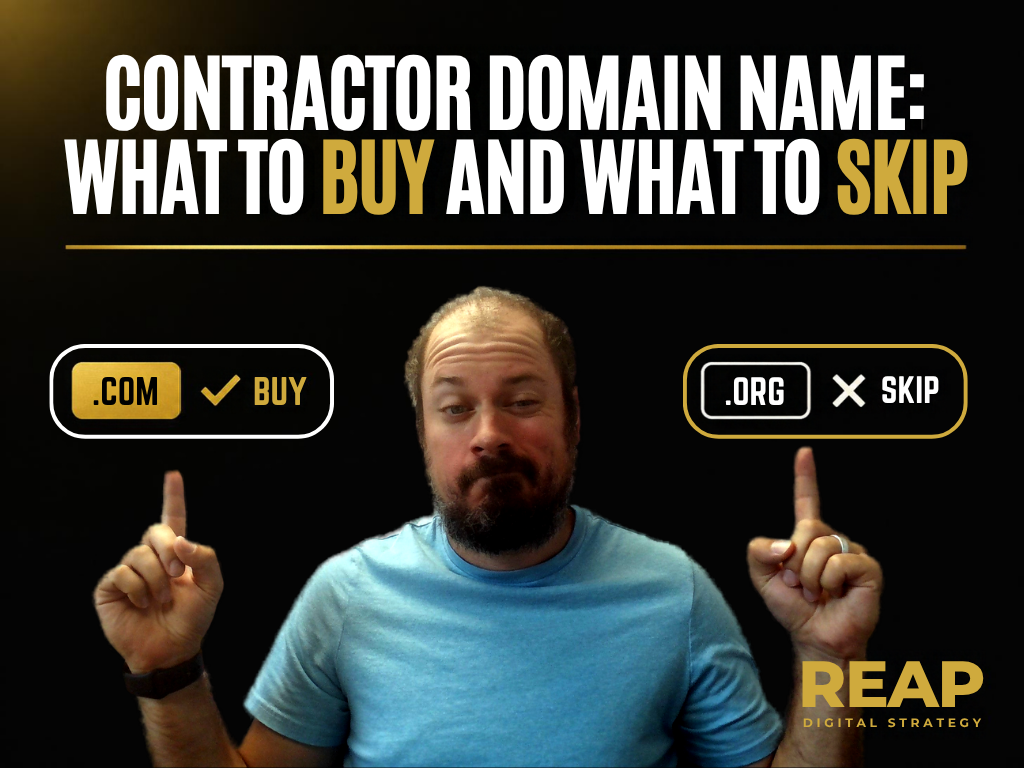
Contractor Domain Name: What to Buy and What to Skip
If you’re starting a tree service, roofing company, or any local trade business, the domain name is one of the first things that holds people up. It shouldn’t. Whether you work in Jefferson County, South County, or anywhere else around St. Louis, here’s how to pick one in an afternoon and get back to work.
Which domain extension should a contractor buy?
Buy the .com. Customers type it out of habit, so if you own a .net or .org instead, some of your traffic will end up on somebody else’s site. It also looks the most established, and a homeowner deciding who to let onto their property is looking for that.
Other extensions have a place. A .org fits a church or nonprofit, not a tree company. Trade-specific options like .contractors or .build exist, and some registrars will pitch them to you, but treat them as a last resort. Customers don’t recognize them, they get mistyped, and they can cause trouble with email deliverability. If the .com you want is taken, change the name before you change the extension.
Does the extension help you rank? No. Google doesn’t rank .com above .net, so anyone selling you a different extension “for SEO” is selling you noise.
What makes a good domain name for a contractor?
Short, easy to say, and easy to spell. A common guideline is somewhere between 6 and 14 characters. Treat that as a target, not a rule, because your business name spelled out may run a little longer and that’s fine. What matters is the phone test. Say the domain out loud to a friend. If they have to ask how to spell it, or whether it has a dash, pick something else.
What should you avoid in a domain name?
- Hyphens and numbers. People forget them, and they make your email address awkward to give out over the phone.
- Unusual spellings. Clever spelling costs you every customer who types it the normal way.
- Names that box you in. A domain with a city baked in gets awkward the day you take a job two towns over.
- Old, used domains. If you buy one that was owned before, check its history first. A domain that was used for spam can carry that baggage with it.
Check that the matching social media handles are open before you commit, too.
Should you put “LLC” in your domain name?
Almost never. Nobody types “LLC” when they search for a business, it makes the address longer and clunkier, and no state requires it in a web address. It belongs on your contracts, invoices, and legal paperwork, not your URL.
The one exception is when the name you want is taken and you’re choosing a backup. Even then, a slightly different name usually beats tacking on “LLC.”
One thing worth knowing: register the domain in the business’s name, not your personal one. If the LLC owns the domain, it stays with the company if you ever sell it, add a partner, or hand off the marketing. Contractors who let a nephew or a web designer register the domain under their own account run into this more than you’d think.
While you’re at it, check your business name with the Missouri Secretary of State before you buy anything. Some words, like ones that imply a government agency or a licensed profession, can get a name rejected.
Does a keyword in the name help you rank?
A little, but not the way most people think. The domain itself carries little weight these days. Where a name that includes your service and city can help is your Google Business Profile, because the business name is a known local ranking factor. The gain comes from the name, not the URL.
The cost is brandability. A descriptive name is easy to find but easy to forget, and it’s harder to grow into a second town or a second service. A distinctive name is easier to remember and easier for customers to pass along. Neither is wrong. Pick based on whether your business will grow mostly on referrals or mostly on search.
One caution: Google’s guidelines require the profile name to match your real-world business name, and stuffing keywords into it can get the listing suspended. This only works if the keyword-style name is your actual, legal, signage-level name.
Then move on
A domain costs around $10 to $20 a year. Buy the .com, maybe one defensive variant, and stop thinking about it.
What decides whether your phone rings is how you show up when a homeowner searches “tree service near me.” That comes down to your Google Business Profile, your reviews, and a website that loads fast and puts your phone number where people can find it.
That’s the work we do at REAP Digital Strategy. We help St. Louis area contractors get their Google Business Profile and local search presence working for them. If you want to talk through where yours stands today, tvalli@reapdigitalstrategy.com.